Communism vs Socialism: Understanding the Real Difference (A Simple Guide for Students)
If you’ve ever felt confused trying to tell communism and socialism apart, you’re not alone. These two words get thrown around in news debates, history classes, and political arguments all the time — often used as if they mean the exact same thing. They don’t. They share roots, but they grew into very different trees. This guide breaks down both ideas in plain language, traces their history from the 1800s to today, and uses real-world examples so you walk away with a solid foundation rather than just memorized definitions.
What Is Socialism, Simply Explained
Socialism is an economic and political idea where the community, rather than private individuals, owns and controls the major resources and means of production — things like factories, land, banks, and key industries. The core belief is simple: wealth and resources should be shared more equally among everyone, not concentrated in the hands of a few rich owners.
Think of it like a school where all students share the library, the playground equipment, and the computer lab equally, rather than one wealthy student owning all the books and charging everyone else to read them. That’s the basic spirit of socialism — shared ownership for shared benefit.
Importantly, socialism doesn’t require getting rid of all private property or all elections. Many socialist systems still allow small businesses, private homes, and multi-party democracy. It’s a spectrum, not a single fixed model.
What Is Communism, Simply Explained
Communism takes the idea of shared ownership a big step further. It imagines a society with no private property at all, no social classes, and no government in the final stage — because, in theory, once everyone shares everything equally, there’s no need for rulers or police to enforce fairness. Everyone contributes according to their ability and receives according to their need.
Picture an entire town where nobody owns their house, car, or business individually. Everything — the farms, the factories, the food — belongs to everyone collectively, and decisions are made together for the good of the whole community, not for individual profit.
In Marxist theory, communism isn’t meant to arrive overnight. Socialism is considered a transitional stage — a stepping stone where the state temporarily manages resources — that eventually leads to full communism, where the state itself fades away. In practice, no country has ever reached this final, stateless stage. Every country that has called itself “communist” was actually still in the socialist transition phase, controlled by a strong central government.
Where These Ideas Came From: A Quick History
Both communism and socialism were born as reactions to the Industrial Revolution in 18th and 19th century Europe. Factories were booming, but workers — including children — labored in dangerous conditions for very low pay, while factory owners grew enormously wealthy. Thinkers began asking: is this fair?
The earliest socialist thinkers, sometimes called “utopian socialists,” included Robert Owen in Britain and Henri de Saint-Simon and Charles Fourier in France. They imagined small, idealistic communities built on cooperation instead of competition.
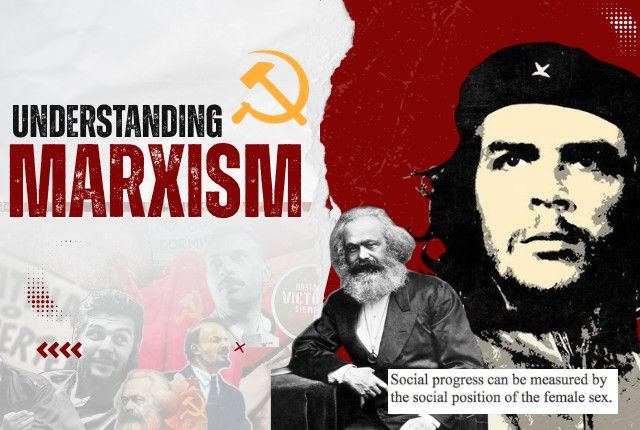
Then came Karl Marx and Friedrich Engels in the mid-1800s. They argued that history moves through stages of class struggle — between those who own the means of production and those who must sell their labor to survive. They believed capitalism would eventually collapse under its own contradictions, workers would rise up, and society would pass through socialism on its way to a classless, stateless communism. Their ideas became the intellectual foundation for both modern socialism and communism, even though later movements split sharply over how to actually achieve that vision.
This split became real in 1917, when the Russian Revolution brought Vladimir Lenin’s Bolsheviks to power, founding the Soviet Union and creating the first major state explicitly built on Marxist communism. Lenin argued that a disciplined, single political party should lead the revolution and run the state during the socialist transition. After Lenin, Joseph Stalin took this further, enforcing strict state control over agriculture and industry, often through brutal and authoritarian means.
Meanwhile, in Western Europe, many socialists took a different path. Figures like Eduard Bernstein argued that socialism could be achieved gradually and peacefully, through elections, labor unions, and reform — not violent revolution. This gave rise to what we now call social democracy and democratic socialism, which kept multi-party elections and some private enterprise alongside strong public services.
Through the 20th century, communism spread to China under Mao Zedong (1949), Cuba under Fidel Castro (1959), North Korea, Vietnam, and parts of Eastern Europe under Soviet influence. Most of these states built single-party governments with centrally planned economies. Socialism, on the other hand, took root differently in places like the United Kingdom, France, and especially the Nordic countries, where it blended with democracy rather than replacing it.
Similarities Between Communism and Socialism
Despite their differences, the two ideas overlap in important ways, which is exactly why people confuse them.
Both grew out of a shared critique of capitalism, arguing that leaving everything to private profit and free markets creates harmful inequality between rich and poor. Both emphasize collective welfare over individual wealth accumulation, believing that resources should serve the community rather than a small elite. Both trace their intellectual roots back to the same 19th-century thinkers, especially Marx and Engels. And both aim, at least in theory, for a more equal society where basic needs like healthcare, education, and housing aren’t dependent on how much money a person has.
Key Differences Between Communism and Socialism
Here’s where the two ideas diverge in practice.
Socialism generally allows a mixed economy — public ownership of major industries alongside private businesses, private property, and personal income that can vary based on work and skill. Communism, in its pure theoretical form, rejects private property and class distinctions entirely, aiming for full economic and social equality.
Socialism is compatible with democracy. Many socialist policies — public healthcare, free education, workers’ rights — exist comfortably within multi-party democratic systems, as seen in countries like Sweden, Denmark, and Norway. Communism, as it has been practiced historically, has almost always involved a single ruling party controlling the state, the economy, and public life, as seen in the Soviet Union, Mao-era China, and present-day North Korea.
Socialism tends to be a permanent system or policy framework — countries can be “more socialist” or “less socialist” depending on how much of the economy is publicly owned. Communism, according to Marxist theory, is meant to be an endpoint, a final stage of human society where government itself disappears — something that has never actually happened anywhere.
Finally, the path to change differs. Democratic socialism usually pushes for reform through voting, unions, and legislation. Revolutionary communism, historically, has often involved overthrowing existing governments entirely and rebuilding the state from scratch.
Communism and Socialism Today
In the present day, pure communism as Marx imagined it — a classless, stateless society — doesn’t exist anywhere in the world. Countries often labeled “communist,” like China, Vietnam, Laos, and Cuba, are more accurately described as socialist states still controlled by a single communist party. China, for instance, officially calls its system “socialism with Chinese characteristics,” combining strong state control of strategic industries with a large private market economy — a major shift from Mao-era policies. North Korea remains one of the most centrally controlled economies left in the world.
Socialism today is much more visible and varied. The Nordic countries — Sweden, Norway, Denmark, and Finland — are often cited as successful examples of democratic socialism or social democracy, combining capitalist markets with strong public healthcare, free education, and generous welfare systems, all within democratic elections. In India, states like Kerala have experimented with socialist-inspired policies around land reform and public health. In the United States and United Kingdom, politicians describing themselves as democratic socialists push for policies like universal healthcare and stronger labor protections, while still operating within a multi-party democratic system.
The Simple Way to Remember the Difference
If you need one clean mental shortcut: socialism is about who owns and shares the wealth, while still often keeping democracy and some private enterprise. Communism is the more extreme, theoretical endpoint where private property and the state itself are meant to disappear entirely — a vision no country has actually achieved, even when they’ve used the word to describe themselves.
Understanding this distinction matters not just for passing an exam, but for reading history, literature, and politics with sharper eyes. Many novels, philosophical texts, and political speeches use these terms loosely or rhetorically, and knowing the real difference helps you see what a writer or speaker is actually arguing — and what they might be glossing over.