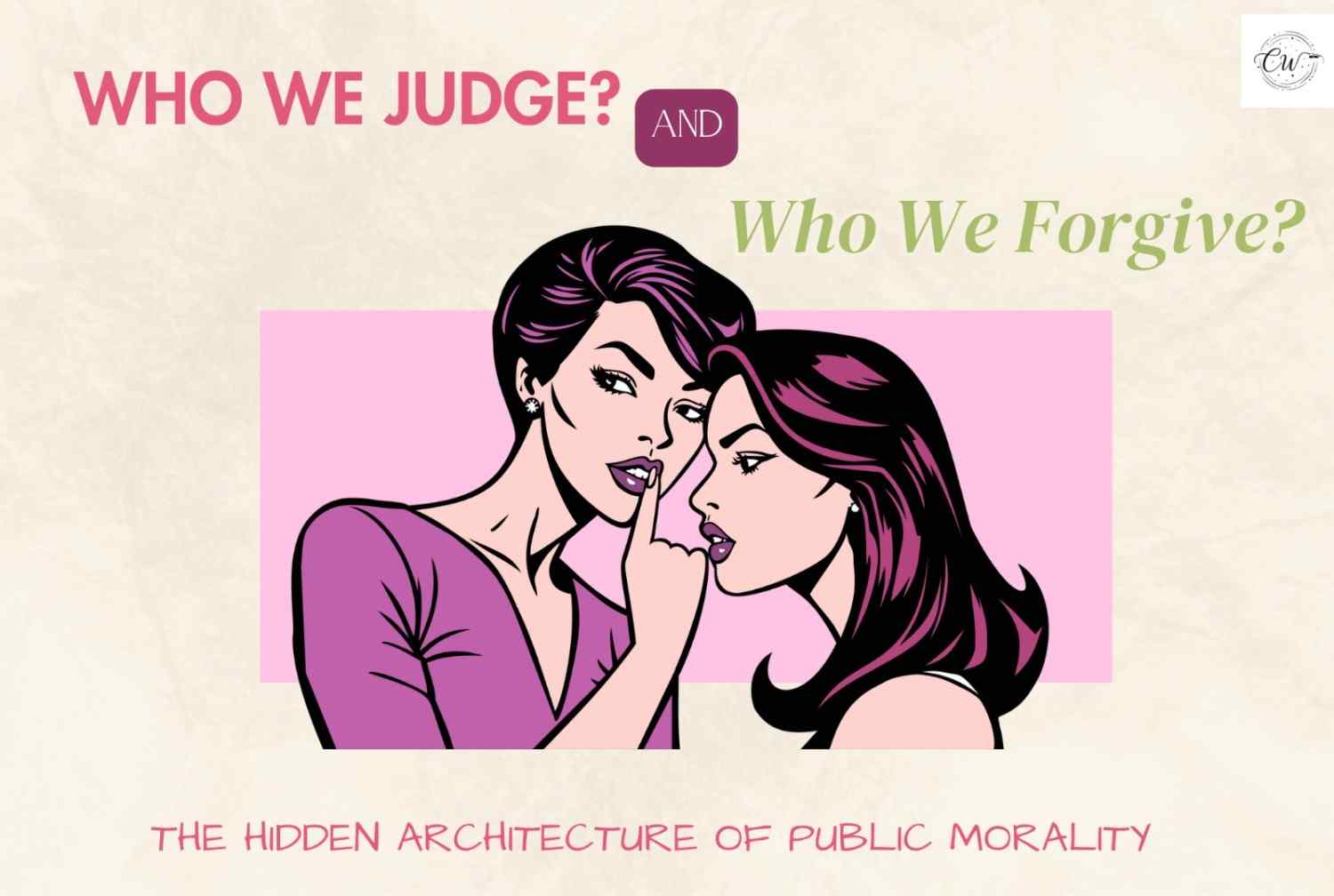
Who We Judge and Who We Forgive: The Hidden Architecture of Public Morality
Consider four figures: a doctor who turns away a poor patient unable to pay full fees; a senior public servant who pockets a bribe that drains public funds meant for the poor; a teacher who quietly inflates grades for students who also happen to be his private tutees; and a woman who, by her own choice, works as a sex worker and lives with environmental awareness. Present these four to any gathering and ask which person makes them most uncomfortable. The answer, most of the time, is the last one. This is not an anomaly of individual prejudice. It is a window into the structural biases that quietly govern how societies decide who deserves condemnation and who deserves a pass.
The Tyranny of Disgust
The psychologist Jonathan Haidt, in his landmark research on moral foundations, identified disgust as one of the most powerful and least rational drivers of moral judgment. In his book The Righteous Mind (2012), Haidt demonstrated that people routinely condemn actions that produce no identifiable victim, simply because those actions trigger a visceral sense of contamination. He called the paralysis that follows moral dumbfounding: the state in which a person insists something is deeply wrong but cannot explain who is harmed or why. The sex worker scenario is a near-perfect real-world demonstration of this phenomenon. The woman in question has made a consensual choice about her own body and livelihood. She hurts no third party. She is, by design of the scenario, even conscientious about the planet. And yet she is condemned more readily than the doctor who withholds care from the sick, or the bureaucrat whose corruption bleeds the public treasury. Philosopher Martha Nussbaum, in Hiding from Humanity (2004), traced this pattern with precision. Disgust, she argued, has historically been weaponised against the marginalized: sex workers, lower castes, LGBTQ+ individuals, the disabled. It is not a moral signal. It is a social one, rooted in anxieties about bodily vulnerability and symbolic purity, not in any calculus of harm.
Invisible Harms and the Normalization of Institutional Betrayal
The public servant who accepts a bribe affecting the poor, and the doctor who refuses a patient over money, represent something far more consequential than discomfort. They represent the abuse of institutional trust, the kind that philosopher Peter Singer, in Practical Ethics (1979), would identify as morally primary precisely because the harm is measurable, direct, and borne by those least able to absorb it. Yet these figures escape the social spotlight. The reason, as sociologist Emile Durkheim observed in The Division of Labour in Society (1893), is that collective conscience punishes not harm per se, but violations of shared moral symbols. A public servant accepting a bribe offends a legal norm. A sex worker offends a cosmological one, a deeply embedded narrative about femininity, respectability, and social order. The corrupt official attends the same dinner parties as before. The sex worker does not. Erving Goffman’s theory of stigma (1963) supplies the sociological language for this: certain occupations produce what he called a spoiled identity, a permanent moral contamination in the eyes of society, irrespective of actual harm caused. The teacher who games the grading system in favour of paying students quietly perpetuates educational inequality, but he remains a respectable figure. The power asymmetry is invisible because it operates within an institution. The sex worker’s work is visible precisely because it transgresses one.
Conventional Morality and the Failure of Moral Maturity
Lawrence Kohlberg’s framework of moral development offers perhaps the most clarifying lens here. In Kohlberg’s schema, conventional moral reasoning, the kind that governs most adults in most societies, judges behaviour by social approval and community norms. Post-conventional reasoning, which Kohlberg considered the higher stage, judges instead by universal principles of harm, rights, and justice. The majority reaction described above is a textbook example of conventional morality. It asks not “Who suffers?” but “What does society think?”. Neuroscientist Joshua Greene, in Moral Tribes (2013), mapped this split onto the brain itself. Emotional, fast-system responses, what Greene calls the automatic settings of moral judgment, are triggered by norm violations such as sex work. Slower, deliberative reasoning, when applied, identifies the doctor and the public servant as the greater threats. The problem is that the emotional brain tends to win. What this pattern ultimately reveals is not that people are malicious, but that public morality, when left unexamined, operates on aesthetic judgments dressed up as ethical ones. It mistakes discomfort for conscience, and social propriety for justice.
Conclusion
The real scandal, as Bertrand Russell once observed, is how often societies confuse moral emotion with moral reason. A culture that reserves its loudest disapproval for a consenting adult’s private choices, while extending institutional respectability to those who exploit the vulnerable, has not developed a moral compass. It has developed a moral costume. A just society, as both Nussbaum and Singer argue, would measure moral failure by its consequences: who is left without a doctor, whose children inherit a rigged classroom, whose livelihood is stolen by the official who should have protected it. Until public morality is grounded in harm rather than disgust, the most powerful will continue to cause the most damage in the most comfortable silence.