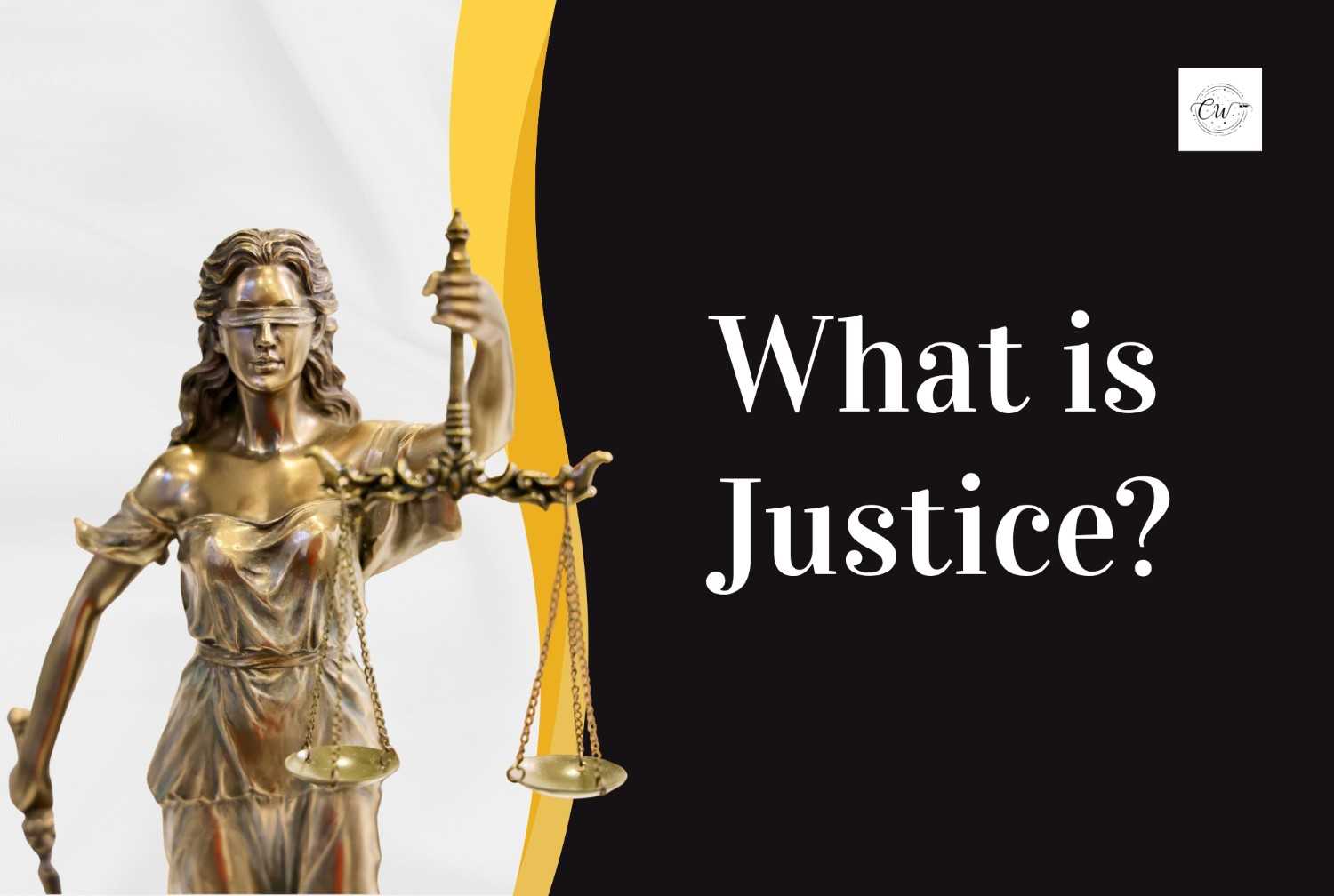
What is Justice?
The idea of justice has haunted human thought from its earliest philosophical articulations to contemporary debates in law, economics, and political theory. It is a concept so foundational that societies collapse into disorder without it, yet so contested that no single definition commands universal acceptance. Is justice merely the maintenance of social order? Is it reducible to economic efficiency? Does it derive from divine command, or is it an evolving human construct grounded in reason and experience? These questions are not merely academic, they shape constitutions, legal systems, and everyday moral judgments.
At its core, justice concerns the fair distribution of benefits and burdens, the right ordering of social relations, and the moral justification of institutions. Yet each of these elements invites disagreement. What counts as “fair”? Who decides what is “right”? And on what basis do we justify one arrangement over another? To understand justice, one must navigate between competing traditions—classical, liberal, utilitarian, Marxist, and contemporary pluralist theories—each of which offers a distinct grounding for the concept.
Justice as Order: The Classical Foundations
The earliest systematic account of justice in Western philosophy appears in Plato’s Republic. For Plato, justice is not primarily about individual rights or distributive fairness, but about harmony that is both within the individual soul and within the state. A just society is one in which each class performs its proper function: rulers govern with wisdom, warriors defend with courage, and producers sustain the material needs of society. Justice, in this sense, is a structural virtue; it is the condition under which each part fulfils its role without interfering with others.
This conception of justice is deeply tied to the idea of order. It is less concerned with equality or liberty than with stability and coherence. Justice ensures that the social organism functions as a unified whole. However, this raises an immediate problem: Plato’s model justifies hierarchy and limits individual autonomy. If justice is merely the correct arrangement of parts, it may legitimize inequality so long as it contributes to systemic harmony.
Aristotle refines this view by introducing a more nuanced account of distributive and corrective justice. For Aristotle, justice is fundamentally about proportional equality—treating equals equally and unequals unequally, in proportion to their merit. Distributive justice allocates goods according to desert, while corrective justice rectifies wrongs in transactions. Unlike Plato, Aristotle places greater emphasis on fairness and reciprocity, grounding justice in rational principles rather than metaphysical harmony.
Yet even Aristotle’s framework presupposes a particular social order—one that includes slavery and excludes women from full citizenship. This highlights a recurring tension: theories of justice often reflect the social contexts in which they arise, raising doubts about their universality.
Justice as Contract: The Liberal Turn
The early modern period shifts the focus from cosmic order to human agreement. Thomas Hobbes, writing in the shadow of civil war, argues that justice arises from a social contract designed to escape the chaos of the state of nature. In his view, justice is not an inherent moral property but a product of covenant: it consists in keeping agreements. Without a sovereign authority to enforce these agreements, concepts like right and wrong lose their meaning. Justice, therefore, is grounded in the necessity of maintaining social order.
John Locke offers a more optimistic account. While he agrees that political authority emerges from consent, he grounds justice in natural rights like life, liberty, and property, that exist prior to the state. The role of government is to protect these rights, and any violation constitutes injustice. Here, justice is no longer merely about order; it is about safeguarding individual freedom against arbitrary power.
This liberal tradition culminates in the work of John Rawls, whose A Theory of Justice redefines the concept for the modern era. Rawls imagines a hypothetical “original position” in which rational individuals choose principles of justice behind a “veil of ignorance,” unaware of their own social status, talents, or preferences. Under such conditions, he argues, individuals would adopt two principles: equal basic liberties for all, and social and economic inequalities arranged to benefit the least advantaged (the difference principle).
Rawls’ theory is neither purely economic nor purely moral; it is a synthesis grounded in fairness as impartiality. Justice, for Rawls, is not about maximizing aggregate welfare but about ensuring that institutions are structured in a way that no one could reasonably reject. This marks a decisive move away from both utilitarianism and classical hierarchy, toward a conception of justice as fairness embedded in institutional design.
Justice as Utility: The Economic Perspective
In contrast to Rawls, utilitarian thinkers such as Jeremy Bentham and John Stuart Mill ground justice in the principle of utility i.e., the greatest happiness of the greatest number. For Bentham, justice has no independent existence; it is simply a subset of moral rules that promote overall happiness. Laws and policies are just insofar as they maximize pleasure and minimize pain.
This approach introduces a powerful economic dimension to justice. It aligns closely with cost-benefit analysis and welfare economics, where policies are evaluated based on their aggregate outcomes. However, it also faces a profound criticism: it permits the sacrifice of individual rights for the sake of collective benefit. If the suffering of a few increases the happiness of many, utilitarianism may deem it just.
Mill attempts to mitigate this by emphasizing qualitative differences in pleasures and by defending individual liberties as essential to long term utility. Nevertheless, the tension remains. Justice, in the utilitarian framework, is ultimately subordinate to efficiency. It is not an intrinsic moral ideal but an instrument for optimizing social welfare.
Justice as Power and Redistribution: The Marxist Critique
A radically different perspective emerges in the work of Karl Marx, who rejects the very premise of abstract theories of justice. For Marx, concepts like fairness and rights are ideological constructs that reflect underlying economic relations. In a capitalist society, what is called “justice” often serves to legitimize exploitation. The legal system, property rights, and even moral norms are shaped by the interests of the ruling class.
Marx does not offer a traditional theory of justice; instead, he envisions a classless society in which the conditions that give rise to injustice (private property and class division) are abolished. In such a society, distribution would follow the principle “from each according to his ability, to each according to his needs.” Justice, in this sense, is not about optimizing or regulating existing structures but about transforming them entirely.
This critique exposes the limits of theories that ignore power and material conditions. It suggests that justice cannot be understood purely in normative or abstract terms; it must be situated within the dynamics of economic production and social conflict.
Beyond Singular Foundations: Pluralism and Capabilities
Contemporary thought increasingly recognizes that no single foundation, be it economic, moral, or institutional, can fully capture the complexity of justice. Amartya Sen, for instance, critiques transcendental theories like Rawls’ for focusing too much on ideal institutions and too little on actual outcomes. Sen proposes a comparative approach, emphasizing the reduction of injustice rather than the attainment of a perfectly just society.
Central to Sen’s framework is the idea of capabilities, i.e. the real freedoms individuals have to lead the lives they value. Justice, therefore, is not merely about the distribution of resources or the maximization of utility, but about expanding human potential. This shifts the focus from abstract principles to lived experiences, from institutional design to human flourishing.
Sen’s approach also bridges the gap between economics and morality. It acknowledges the importance of material conditions while insisting that well-being cannot be reduced to income or utility. Justice, in this view, is inherently multidimensional, encompassing health, education, dignity, and participation.
Justice and the Question of the Divine
The idea that justice is divinely ordained has played a central role in many religious traditions. In such frameworks, justice is not constructed by human reason but revealed through sacred texts and divine authority. While this provides a powerful moral foundation, it also raises questions about interpretation and pluralism. In a world of diverse beliefs, whose conception of divine justice should prevail?
Modern secular theories tend to avoid grounding justice in theology, not because they deny its importance, but because they seek principles that can be justified in a pluralistic society. Rawls, for example, emphasizes “public reason” arguments that all citizens can accept regardless of their “dharmic” beliefs. This reflects a broader shift: justice is increasingly understood as a human project, even if it draws inspiration from transcendent ideals.
Conclusion: Justice as an Ongoing Project
The idea of justice resists reduction to any single principle or domain. It is not merely economic optimization, though efficiency matters. It is not solely religious morality, though ethical traditions shape our intuitions. It is not just the maintenance of social order, though stability is essential. Nor is it an entirely divine abstraction detached from human agency.
Justice is, rather, an evolving synthesis of these elements, a normative framework through which societies negotiate the distribution of power, resources, and recognition. It is grounded in reason, shaped by history, contested through politics, and realized imperfectly through institutions.
What emerges from this exploration is not a definitive answer, but a deeper understanding of the stakes involved. To ask “what is justice?” is to ask how we ought to live together, what we owe to one another, and what kind of society we aspire to build. It is a question that admits no final resolution, only better and worse answers. Answers that must be continually revised in light of new challenges and new insights.
In this sense, justice is less a fixed ideal than an ongoing project: a commitment to critical reflection, moral reasoning, and the pursuit of a more equitable world.
Disclaimer: The views and opinions expressed here are solely those of the author and do not necessarily reflect the views of Civicwit.