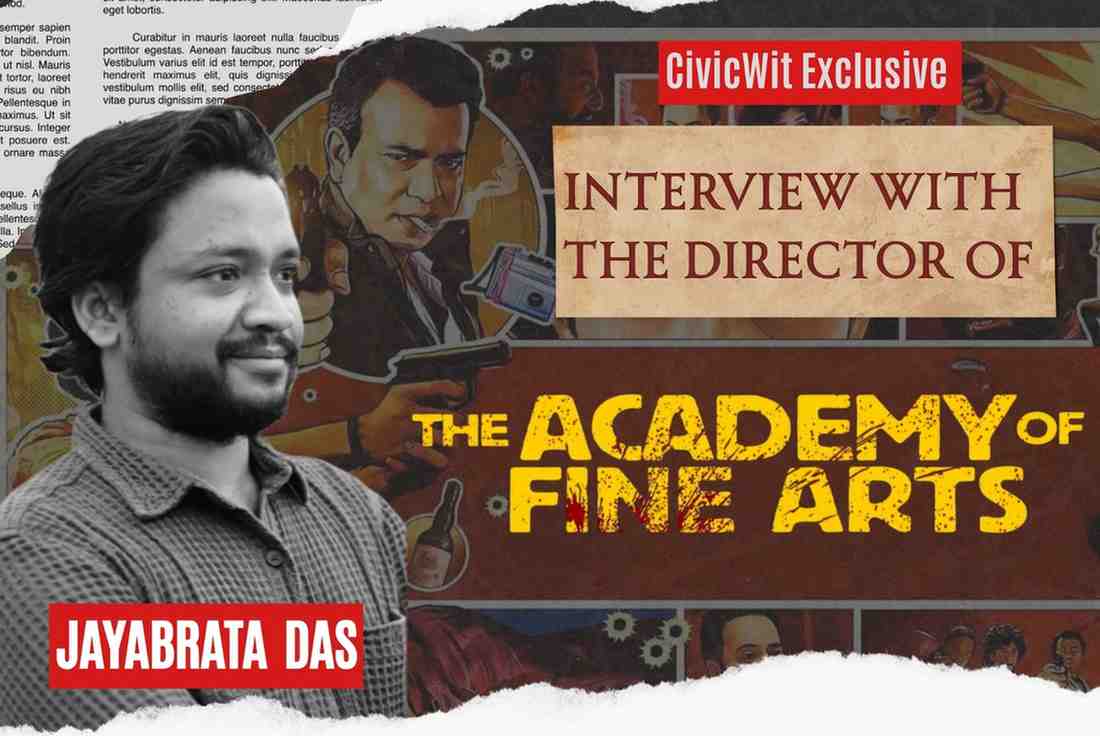
The Making of The Academy of Fine Arts: An Exclusive Interview with Director Jayabrata Das
Independent filmmaking in Bengal can be called a rebellion and to the director Jayabrata Das, his first feature film The Academy of Fine Arts has been a full-scale rebellion. Jayabrata, an alumnus of the Satyajit Ray Film and Television Institute (SRFTI), did not go straight into the limelight, his time on the big screen was typified by a four-year-long production nightmare, including crowdfunding obstacles and a star-level clash with the film federation over technical procedures. Following a period of significant struggle, his film has finally gained widespread recognition; the full interview follows below.
1) What inspired you to make The Academy of Fine Arts?
“Every film I have watched till date – all of them inspired me to make this film.”
2) You were a student at SRFTI. How was your experience there?
“SRFTI shaped me deeply. It gave me discipline, exposure, and a strong sense of cinema history. But it was also tough. You constantly question yourself there. You fail, you argue, you feel lost. That friction is important. This film wouldn’t exist without that experience, both the good and the uncomfortable parts.”
3) What were the biggest challenges of making the film with limited resources and your own funds/crowdfunding?
“Everything was a challenge. Money, time, logistics, mental pressure. When you’re using your own savings or asking friends to contribute, the responsibility doubles. You can’t waste a single day or a shot. At times we had to choose between what we wanted to shoot and what we could afford to shoot. But that limitation also forced us to be inventive.”
4) About the objection from FCTWEI regarding technicians and the “student film” label—what is your take?
“When we started, it was genuinely a student-driven project. The core team consisted of students and young professionals working for learning and passion. Over time, the film grew. Post-production, promotion, and release made it look bigger. I understand the federation’s concern, but intent matters. This was never an attempt to bypass anyone. It was about survival and finishing a film that started as a learning exercise.”
5) Do you think mandatory technician rules can stifle creativity or make filmmaking harder for newcomers?
“Rules are important for protecting workers, no doubt. But cinema also needs flexibility for first-time filmmakers. A rigid structure can make entry impossible for people without backing. There should be space for small films, experimental films, and student-origin projects to exist without fear. Balance is the key.”
6) The film was supposed to release on 14th November but released on 21st. What happened?
“The delay happened due to unresolved issues related to permissions, screenings, and pressure around the release. There were discussions, objections, and uncertainty. We didn’t want chaos or confrontation. So we paused, sorted things out, and released the film a week later in a more stable situation.”
7) What are your hopes for audience reception, especially with the controversy?
“I hope audiences watch the film as a film, not as a headline. Controversy fades, but cinema stays. If even a section of viewers connects with the characters or sees their own struggles reflected, that’s enough for me.”
8) You started filming in 2021. Why did it take 4 years, and how do you feel now?
“The delays were due to money issues, post-production gaps, the pandemic aftermath, and later the release complications. Independent films don’t move in straight lines. Now that it’s finally running in theatres, I feel relieved more than proud. It feels like a long-held breath has been released.”
9) What lessons did you learn from this conflict? Will it change how you work next time? And your thoughts on the future of Bengali cinema?
“I’ve learned the importance of communication, paperwork, and understanding systems early. Passion alone is not enough. For my next film, I’ll be more prepared structurally. As for Bengali cinema, I think it’s at a crossroads. New voices are coming, but survival is hard. If we don’t create space for small and independent films, we’ll lose an entire generation of storytellers.”
10) Any message for critics, the federation, or the audience?
“To the critics – judge the film honestly. To the federation – dialogue is always better than conflict. We are not enemies. And to the audience – thank you for showing up. Watching a small film in a theatre is the biggest support an independent filmmaker can get.”
Ultimately, The Academy of Fine Arts is a film that refused to be silenced. The journey is more than just a production timeline; it is a testament to the grit required to create art in an increasingly rigid industry. Jayabrata Das’s story reminds us that while the “limelight” is often the goal, the true soul of cinema is born in the friction of the struggle. As the film finally graces the silver screen, it stands as a victory for every independent creator who has ever been told their vision was too small, too broke, or too bold to survive.