Why High-Functioning People Often Miss the Earliest Signs of Mental Deterioration
The colleague who never misses a deadline, the friend who “just pushes through”, the family member who insists they’re fine while twitching like an overcaffeinated squirrel — these high-functioning individuals are society’s favourite illusion of “success”. They appear to thrive on the surface, while quietly eroding from the inside out. When we think of burnout, the image is that of a person who can’t get out of bed, or simply just gives up. But the real problem begins long before that, in the subtle early stages that high-functioning people are uniquely equipped to, or rather conditioned, to overlook.
The Mask of Competence
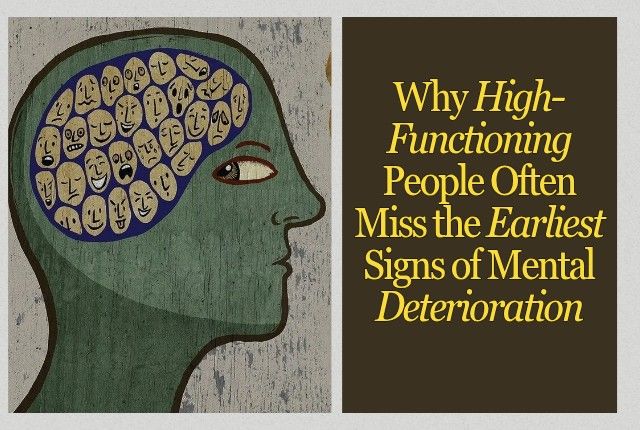
Competence becomes the mask under which high-functioning people survive – the one label that turns their stress into something that is to be perceived as healthy. Productivity turns into a shield, and achievements act like noise-cancelling headphones for emotional distress. Highly effective. Until it isn’t.
Why Self-Image Blocks Awareness
Most high-functioning people make it their identity to be productive all the time, to chase achievement after achievement. They reach a stage where they lose sight of who they are if not capable, reliable and resilient. The downside is, when early signs of burnout (fatigue, irritability, cognitive fog) start, their brain rejects these like a poorly written plot twist.
Admitting they’re overwhelmed would mean they would have to admit that they can’t handle everything, and that’s an unthinkable task for them.
The Perfectionism Trap
Having the need to be perfect at anything and everything they do worsens the situation for high-functioning individuals. For them, struggle becomes a moral failure; rest is unacceptable, and so is asking for help. The result? Their nervous system becomes a pressure cooker that no one ever turns off.
Society Rewards the Wrong Signals
The most tragic part is that society praises high-functioning burnout. We applaud the person who answers emails at midnight. We idolize the chronically overscheduled. We label exhaustion as “dedication”. It’s like giving a gold star to someone whose house is on fire because they kept sweeping the floor anyway.
The Quiet Collapse
By the time these individuals realize something is wrong, they’re often deep into emotional depletion. Their collapse is sudden and dramatic; not because the symptoms weren’t there, but because they were expertly ignored, minimized, or rationalized.
What Needs to Change
We need a cultural shift in how we define strength. Strength is not the ability to function while unwell. It’s recognizing when you shouldn’t have to. For high-functioning individuals, awareness must become preventative, not reactive. The early signs matter. The small cracks matter. The subtle whispers matter. Burnout doesn’t start with catastrophe. It starts with a quiet, persistent “I’m fine” that should have been “I need a break”.