Reimagining India’s Direct Taxation System through the lens of capability approach
Abstract
This paper examines how India’s direct taxation system can be restructured using the capability approach, developed by Amartya Sen, and guided by Rawls’ theory of justice. While the Indian Income Tax Act, 1961, includes progressive tax rates and various deductions aimed at promoting fairness, in practice it does not fully ensure that all citizens can achieve real opportunities or meaningful freedoms. Many households, especially those with low income, are pushed into poverty due to high out-of-pocket health expenditures, and wealth is increasingly concentrated in the hands of a small section of society. These gaps show that income redistribution alone is not enough; what matters is whether people are able to use their income to live healthy, educated, and secure lives. By examining statistical data and real-life examples, the paper highlights how the current tax provisions, such as deductions for health insurance or medical treatment and the lack of inheritance and wealth taxes, fail to address these capability gaps. A capability-oriented tax system, in contrast, would focus on expanding substantive freedoms rather than only collecting revenue. It would include measures such as higher or targeted deductions for healthcare and education, refundable tax credits for low-income groups, and moderate wealth taxation to reduce extreme inequality and support the least advantaged. Such a system would align with India’s constitutional mandates under Articles 21, 38, and 39, promoting social justice, equality, and human development. By combining the normative guidance of Rawls with Sen’s emphasis on actual capabilities, this paper argues that taxation can be transformed from a tool of revenue collection into a mechanism that truly empowers citizens, giving them the real freedom to pursue education, healthcare, livelihood, and dignity. This approach provides a framework for policymakers to rethink tax laws in India in a way that addresses structural inequalities and creates a more just society where all individuals can convert their resources into meaningful life outcomes.
Introduction
Taxation has long been recognized as the cornerstone of state revenue. However, it has not always been in the form of redistributive justice. In the ancient times taxation was more of a reciprocal social contract as seen in case of Bali in the ancient Indian times. But in the later parts of the history and especially in the medieval times during the ruling of the Delhi Sultanate and later the Mughal Empire tax became nothing other than a form of revenue extraction and the goal for it was ensure that the empire survives and thrives. The benefit of the citizens did not hold much importance. The same held true for the British era as well during which British kept of extracting taxes to the extent that it resulted in multiple famines across Bengal and other states and the lost of many lives. However, the modern approach for the taxation is much different. While taxation is an important source of revenue for the govt and ensuring stability, taxation has also become a tool that can be used for the purpose of welfare.
In India, direct taxation, which comprises of income tax, corporate tax, and related levies—has historically been justified on two normative grounds i.e. the ability-to-pay principle, which advocates progressive taxation based on income or wealth, and the benefit principle, which equates tax obligations with benefits received from state services. While these frameworks remain central to fiscal policy, they are limited in their conception of fairness. However, both approaches reduce distributive justice to the allocation of financial resources, without accounting for the deeper question of whether taxation enhances the real freedoms of individuals to live dignified and flourishing lives.
Philosophical debates in political theory have attempted to ground taxation in broader notions of justice. John Rawls, through his Theory of Justice, argued that inequalities are permissible only if they work to the advantage of the least advantaged members of society. This Rawlsian lens provides a powerful justification for progressive taxation, linking fiscal policy to fairness in the distribution of primary goods. However, as critics, most notably Amartya Sen, have argued, Rawls’ focus on “primary goods” neglects the fact that individuals differ significantly in their ability to convert resources into meaningful outcomes. Equal shares of income or wealth may not translate into equal opportunities, particularly for individuals disadvantaged by disability, discrimination, or systemic barriers.
Amartya Sen’scapability approach offers an alternative evaluative framework: justice should be assessed not merely in terms of resources or utilities, but in terms of people’s capabilities—their substantive freedoms to achieve valuable functioning such as being educated, healthy, and secure. Despite its growing influence in welfare economics and development studies, the capability approach has scarcely been applied to taxation. This creates a significant research gap: Can direct taxation be reimagined not merely as a mechanism for revenue collection and income redistribution, but as a tool for enhancing human capabilities?
This paper seeks to explore that question, examining the potential of a capability approach-based tax system in India, while drawing on Rawlsian principles to ground the normative justification of fairness.
Theoretical Foundations
Direct Taxation and Normative Justifications
Direct taxation refers to taxes levied directly on individuals or organizations, primarily in the form of income tax, corporate tax, and previously wealth tax. The normative foundation of direct taxation has historically rested on two main principles: the ability-to-pay principle and the benefit principle.
The ability-to-pay principle posits that taxation should be levied according to a taxpayer’s economic capacity, which justifies progressive income tax structures. Higher-income individuals bear a greater tax burden on the basis that they can afford to contribute more without compromising their welfare. This principle underpins most modern tax systems and is often invoked in discussions of redistributive justice. However, the principle is limited because it equates fairness with resource equality. The benefit principle holds that taxes should correspond to the benefits individuals receive from public goods and services. For instance, those who consume more public infrastructure or security should contribute proportionately. While intuitively appealing, this principle faces two criticisms. First, it is practically difficult to measure the “benefit” of state services to individuals. Second, it risks justifying regressive outcomes, since poorer individuals may appear to benefit less in monetary terms but depend more critically on public provision for survival.
According to Amartya Sen “Development consists of the removal of various types of unfreedoms that leave people with little choice and little opportunity of exercising their reasoned agency.[1] Therefore, real development is not merely growth in income, GDP, or industrialization. Instead, development is fundamentally about expanding human freedoms. These freedoms are both the means and ends of development. Real development involves removing the various “unfreedoms”—such as poverty, lack of political rights, social deprivation, and limited access to health and education—that restrict people’s opportunities to live the lives they value. The purpose behind taxation in a welfare state is to perform those welfare functions and enhance the capability of individuals. Once a section of society has sufficiently been made capable then their income will increase and therefore that income will become taxable. The tax collected from these people will be used for developing another underprivileged section of the society and then once their income increases they can be brought under the taxation and this entire cycle will keep on continuing. But for this entire philosophy to work, it is also important to assess whether equal resource allocation translates into equal opportunity or freedom.
The justice in taxation cannot be reduced to questions of resource allocation. We cannotneglect non-monetary dimensions such as health, education, or social participation. The existing principles do not fully capture structural inequalities that prevent individuals from converting resources into real freedoms.
This limitation has motivated the search for richer philosophical frameworks to ground taxation in broader theories of justice, most prominently those developed by John Rawls and Amartya Sen.
Rawls’ Theory of Justice and Taxation
John Rawls’ A Theory of Justice (1971) remains one of the most influential works in modern political philosophy. Rawls proposed two principles of justice:
- Equal Basic Liberties: Each person has an equal right to a fully adequate scheme of basic liberties, such as freedom of speech, association, and political participation.
- Difference Principle: Social and economic inequalities are permissible only if they are arranged to the greatest benefit of the least advantaged, and attached to offices open to all under conditions of fair equality of opportunity.
The Difference Principle is of particular importance to taxation. It provides a normative justification for progressive taxation: higher burdens on wealthier citizens are justified insofar as the redistribution benefits those in the lowest positions. Rawls’ approach thus links taxation not merely to resource allocation, but to a structural principle of fairness.
However, Rawls’ framework has been subject to criticism, especially from Amartya Sen. Rawls focuses on the distribution of primary goods—rights, liberties, opportunities, income, and wealth—as the metric of justice. Sen argues that individuals vary in their ability to convert primary goods into real well-being. For instance, a disabled person may require significantly more resources to achieve the same level of functioning as an able-bodied individual. In such cases, an equal allocation of primary goods does not necessarily secure fairness.
Applied to taxation, Rawlsian theory supports progressive redistribution but does not account for personal or structural variations in the effectiveness of resources. While the Difference Principle secures the position of the least advantaged in terms of primary goods, it overlooks the conversion problem—the disparity between having resources and being able to use them effectively. This creates a gap that Sen’s capability approach seeks to fill.
Sen’s Capability Approach and Taxation
Amartya Sen’s capability approach shifts the focus of justice from resources or utilities to capabilities—the real freedoms individuals have to achieve “functionings” they value, such as being healthy, educated, or socially active. Capabilities represent substantive opportunities, not just formal rights, or income levels.
From this perspective, taxation should not be judged merely by how much revenue it raises or how equal it makes incomes appear, but by whether it expands or restricts people’s capabilities. For instance, a tax incentive for higher education that primarily benefits the already well-off fails the capability test if it does not expand access for disadvantaged groups. Similarly, the abolition of wealth tax in India may increase revenue efficiency but exacerbates intergenerational inequalities in capabilities such as access to quality education and healthcare.
The capability approach also emphasizes heterogeneity: different individuals need different amounts and types of resources to achieve similar levels of functioning. This implies that a fair tax system should be sensitive to personal circumstances. For example, a person with a disability or chronic illness may justifiably require greater deductions or lower effective taxation than someone with equal income but fewer conversion challenges.
In practice, a capability-based tax system would ask:
- Does taxation ensure that all citizens achieve a basic threshold of capabilities (education, health, income security)?
- Do exemptions and deductions actually enhance capabilities, or simply subsidize privilege?
- Does redistribution reduce capability deprivation, not just income inequality?
In contrast to Rawls’ emphasis on primary goods, Sen’s approach provides a more dynamic evaluative framework for taxation—one that aligns fiscal policy with the broader goal of human development.
Towards a Capability Approach-Based Tax System in India
The adoption of a capability approach-based framework into Indian fiscal policy requires both theoretical justification and practical adaptation of the Income Tax Act, 1961. While the Act has evolved considerably, particularly after liberalisation in the 1990s and the gradual lowering of corporate and personal tax rates, it remains largely guided by the ability-to-pay principle and efficiency-driven objectives. This section explores how the capability approach can be translated into law and practice within India’s direct taxation regime.
The Current Framework of Indian Direct Taxation
The Income Tax Act, 1961 (hereinafter ITA 1961) governs direct taxation in India, covering individuals, Hindu Undivided Families (HUFs), firms, companies, and other entities. Its structure reflects three dominant objectives:
- Revenue Collection – income tax constitutes ~51% of the Union government’s gross tax revenue[2].
- Equity through Progressivity – under Section 4 read with the First Schedule, individual taxpayers are charged on a slab basis, with rates increasing with income.
- Incentivisation of Economic Activity – deductions under Chapter VIA (Sections 80C–80U) provide relief for investments, insurance, education, and healthcare, while corporate tax holidays under provisions like Section 80-IA incentivise infrastructure and industrial development.
While these mechanisms pursue redistribution and growth, their design often reinforces inequality. For instance:
- Section 80C deductions disproportionately benefit middle- and high-income earners who can afford savings instruments like life insurance or provident funds.
- The abolition of Wealth Tax Act, 1957 in 2015 removed a crucial tool for tackling extreme wealth concentration.[3]
- Informal sector and gig workers, who form nearly 80% of India’s labour force, remain largely outside direct tax structures but also outside redistributive benefits.[4]
This highlights the research gap: Indian taxation policy redistributes income in form but often fails to secure substantive freedoms—healthcare, education, income security—especially for vulnerable populations and therefore inefficient in achieving human development and welfare.
Capability Approach as a Framework for Indian Tax Policy
The capability approach provides a normative foundation for reimagining Indian tax law. Instead of evaluating fairness in terms of income or wealth, it asks whether taxation enhances citizens’ capabilities to achieve basic functionings. Translated into legal terms, a capability-based tax system would embed three principles within the ITA 1961:
- Minimum Capability Thresholds– Every citizen should enjoy a baseline of essential capabilities: education, health, housing, and security. Taxation must be designed to finance these guarantees.This resonates with Directive Principles of State Policy (Articles 38 and 39, Constitution of India) which mandate the State to minimize inequalities and provide adequate means of livelihood.
- Heterogeneity and Conversion Factors– Different taxpayers face different conversion challenges: disability, gender, geography. The ITA already provides deductions under Section 80U (for persons with disability) and Section 80DDB (for medical treatment of specified diseases). However, these limits are modest (₹75,000 under Section 80U for disability; ₹1,00,000 under Section 80DDB for senior citizens).A capability-oriented system would expand these deductions to reflect the real cost of achieving equal functionings.
- Intergenerational Capability Justice– By abolishing wealth tax and neverimplementing estate duty after its repeal in 1985, India entrenches inherited advantage.Reintroducing a moderate inheritance/estate tax would align with Sen’s framework, preventing concentration of capabilities across generations.
Integrating Capability Approach into the Income Tax Act, 1961
A restructured ITA, guided by the capability approach, could adopt the following measures:
(a) Redesign of Exemptions and Deductions (Chapter VIA)
Currently, Section 80C provides deductions up to ₹1,50,000 for investments in provident funds, insurance, tuition fees, and housing loan repayments. This provision is regressive because only those with disposable income can avail its benefits.
- A capability-based system would differentiate deductions: higher relief for lower-income groups and deductions strictly linked to capability expansion sectors (education, healthcare, social security).Example: Tuition fee deduction should be capped higher for first-generation learners from disadvantaged backgrounds, consistent with Article 21A (Right to Education).
(b) Disability and Health-Oriented Reliefs
Sections 80U and 80DDB need revision to reflect the actual costs of healthcare in India. Studies (NITI Aayog, 2021) show that catastrophic health expenditure pushes 7% of Indians into poverty annually.[5]
- Deduction ceilings should be indexed to healthcare inflation.A new section could allow full deductibility of health insurance premiums for low-income households, linking taxation directly to the capability of maintaining health.
(c) Corporate Tax Incentives and Employment Capabilities
Corporate tax holidays under Sections 80-IA, 80-IAB, and 10AA often subsidize capital-intensive sectors that generate limited employment.
- A capability-oriented reform would tie corporate tax incentives explicitly to employment generation, skill training, and capability-building outcomes.For example, a tax rebate could be conditional upon companies providing vocational training, thereby enhancing the workforce’s functioning capabilities.
(d) Wealth and Inheritance Taxation
The absence of a wealth or estate tax exacerbates intergenerational inequality in capabilities. Comparative jurisdictions (e.g., France, Spain, Norway) levy wealth/inheritance taxes specifically to reduce concentration of wealth.
- Reintroducing an estate duty law in India, with exemptions for small and medium estates but progressive rates on ultra-high net worth individuals, would operationalize the capability principle of fair equality of opportunity.
(e) Gig Economy and Informal Sector Integration
Gig workers (e.g., drivers, delivery agents, digital freelancers) are treated ambiguously under the ITA—neither fully salaried nor fully self-employed.
- Section 44ADA offers presumptive taxation for professionals, but no parallel exists for gig workers.A new provision could establish a capability-linked presumptive taxation scheme, where gig workers contribute modestly to direct tax but automatically receive state-backed health insurance and pension support. This would convert taxation into a dual tool: revenue and capability protection.
Capability Approach vs Rawls in Indian Context
While Rawls’ Difference Principle justifies progressive taxation, it evaluates fairness through the distribution of primary goods. In India, this has led to progressive tax slabs (Section 4 with Finance Act, annual budgets) but not necessarily to real improvements in freedoms for the least advantaged.For example, progressive tax rates generate revenue, but under Rawlsian analysis, their fairness is assessed by aggregate redistribution.Under the capability approach, the analysis would ask: Has the additional revenue translated into improved access to schools, hospitals, housing, and social participation for marginalized groups?Has there been human development?
Thus, Rawls provides a baseline justification for progressive taxation, but Sen’s approach gives a practical evaluative metric. In implementation, Indian fiscal policy must integrate both:
- Rawls to justify why progressivity is fair.
- Sen to evaluate whether progressivity works in practice to expand real freedoms.
Judicial Recognition of Capabilities in Tax Matters
Indian courts have occasionally acknowledged equity considerations in taxation, though not explicitly framed in capability terms.
The Supreme Court had struck down a flat-rate tax on plantations, holding it violated equality by ignoring differences in land productivity. This reflects sensitivity to conversion factors, akin to capability reasoning.[6]
The Court held that equity, rather than strict literal interpretation, should sometimes guide tax statutes.[7]
These judgments indicate judicial openness to fairness-based reasoning, suggesting that a capability-oriented interpretation of the ITA could be constitutionally coherent.
Constitutional Backing
The incorporation of the capability approach into Indian tax law also aligns with constitutional mandates:
- Article 38(2): The State shall strive to minimize inequalities in income and opportunities.
- Article 39(e)–(f): The State must ensure that citizens are not forced by economic necessity to enter vocations unsuited to their age/strength, and that children are given opportunities for development.
- Article 21 (Right to Life): Expanded by jurisprudence (e.g., Olga Tellis v. Bombay Municipal Corporation, AIR 1986 SC 180) to include livelihood, shelter, education, and health.
Conclusion
A tax system designed around capability expansion would therefore not only be economically rational but also constitutionally mandated.
In summary, Implementing the capability approach into the ITA requires restructuring deductions, reintroducing wealth/inheritance taxation, linking corporate tax benefits to employment capabilities, and formalising gig worker taxation with social protection. Rawls’ framework provides the normative justification for progressivity, while Sen’s approach offers the evaluative lens to ensure taxation expands freedoms. Together, they allow Indian fiscal policy to evolve from mere resource redistribution to capability enhancement, making taxation a tool of justice rather than simply revenue collection.
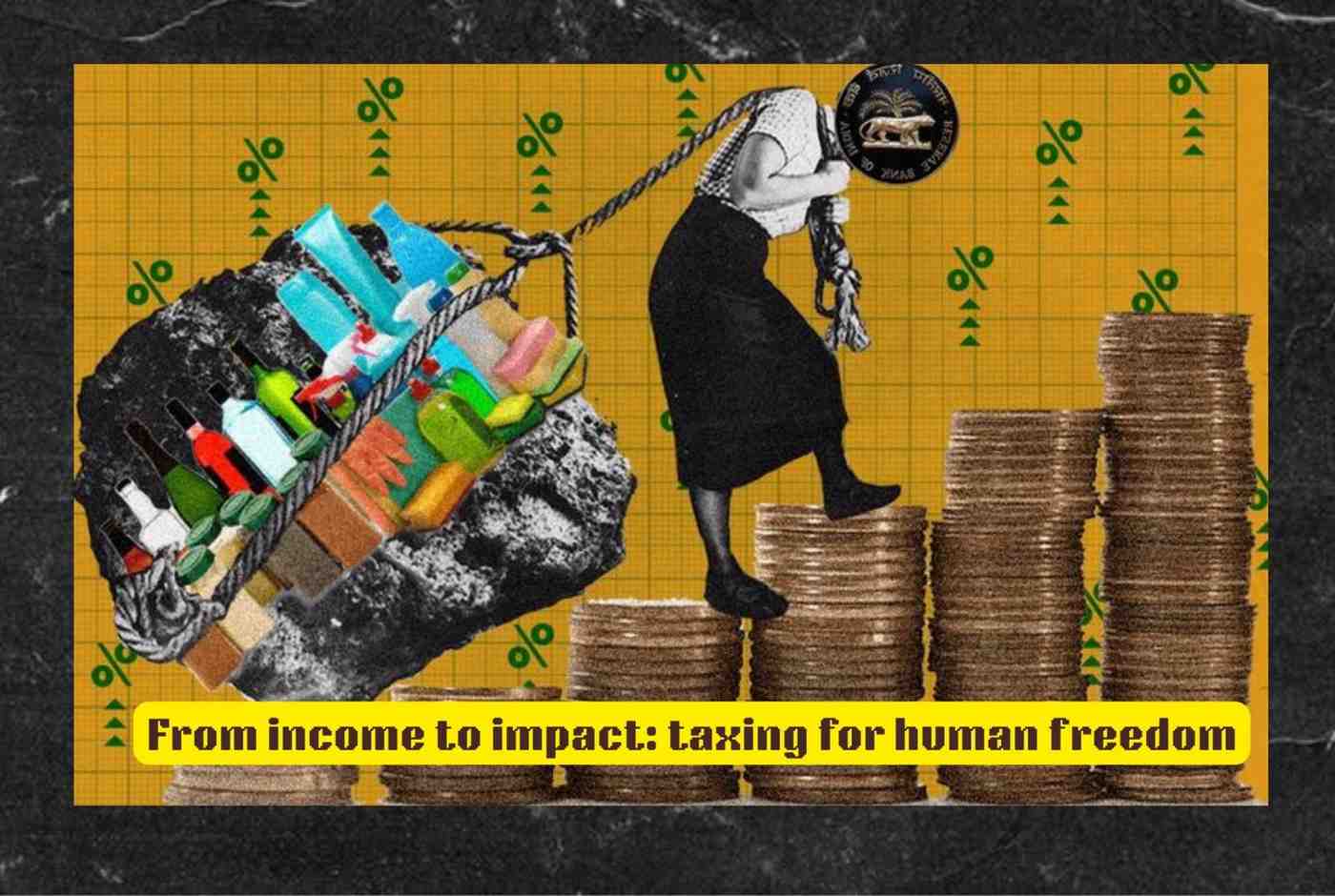
A capability-oriented tax system in India can be illustrated through key empirical insights from health and wealth data. Studies on out-of-pocket (OOP) health expenditures show that current fiscal mechanisms are insufficient to protect the least advantaged. According to the National Sample Survey Organization (2014), the poverty headcount increased from approximately 16.44% to 19.05% of households after accounting for health expenditures, meaning around 6.47 million households were pushed below the poverty line due to medical costs[8]. Similarly, other analyses indicate that approximately 55 million Indians were pushed into poverty in a single year, with 38 million falling below the poverty line solely due to medicine costs[9]. These statistics highlight that current income tax deductions under Sections 80D (health insurance), 80DDB (medical treatment of specified diseases), and 80U (disability) are inadequate to prevent capability deprivation, as the poorest households lack sufficient taxable income to benefit meaningfully from these provisions.
The capability approach therefore suggests restructuring tax relief to directly expand health capabilities, for instance, through higher deductions or refundable tax credits tied to actual healthcare expenditures for low-income households. On the wealth and inequality front, studies indicate that the top 1% of India’s population controls approximately 22.6% of national income and 40.1% of national wealth, underscoring intergenerational disparities in capabilities[10].
With the abolition of wealth tax in 2015 and the absence of estate duty, there is limited mechanism to prevent concentration of opportunities and resources. A capability-based tax design would recommend a moderate reintroduction of wealth or inheritance taxes targeted at ultra-high net worth individuals, with revenue earmarked for programs that expand education, healthcare, and social security for disadvantaged groups. Together, these case studies demonstrate that measurable capability deficits exist despite formal progressivity in the tax system and that targeted fiscal interventions, guided by a capability framework, can more effectively transform income redistribution into real, substantive freedoms.
In summary, these empirical insights illustrate that India’s current tax system, while progressive in design, falls short of ensuring substantive freedoms for the least advantaged. High out-of-pocket health expenditures push millions into poverty, and wealth concentration perpetuates intergenerational inequality, demonstrating clear capability gaps. A capability-oriented reform—through targeted deductions, refundable credits, and moderate wealth taxation—would realign fiscal policy to expand real opportunities and freedoms, ensuring that taxation functions not merely as a revenue tool, but as an instrument of social justice.
Citations
- Sen, A. (1999). Development as Freedom. New York: Knopf.
- Budget 2024–25, Union Ministry of Finance.
- Bharti, N. K., Chancel, L., Piketty, T., &Somanchi, A. (2024). Income and Wealth Inequality in India, 1922-2023: The Rise of the Billionaire Raj
- International Labour Organisation Report, 2021.
- NITI Aayog. (2021). Health Insurance for India’s Missing Middle. Government of India.
- K.T. Moopil Nair v. State of Kerala (1961 AIR 552).
- CIT v. J.H. Gotla (1985 AIR 1698).
- National Sample Survey Organisation. (2014). Social consumption: Health (Schedule 25.0). Government of India.
- Times of India. (2018). Health spending pushed 55 million Indians into poverty in a year: Study. Times of India.
- Business Today. (2024). 22% of income: Why Thomas Piketty thinks India must tax its super-rich now. Business Today.
References
- Rawls, J. (1971). A Theory of Justice. Cambridge, MA: Harvard University Press.
- Sen, A. (1999). Development as Freedom. New York: Knopf.
- Sen, A. (1992). Inequality Reexamined. Harvard University Press.
- Budget 2024–25, Union Ministry of Finance.
- Bharti, N. K., Chancel, L., Piketty, T., &Somanchi, A. (2024). Income and Wealth Inequality in India, 1922-2023: The Rise of the Billionaire Raj
- International Labour Organisation Report, 2021.
- NITI Aayog. (2021). Health Insurance for India’s Missing Middle. Government of India.
- K.T. Moopil Nair v. State of Kerala (1961 AIR 552).
- CIT v. J.H. Gotla (1985 AIR 1698).
- National Sample Survey Organisation. (2014). Social consumption: Health (Schedule 25.0). Government of India.
- Times of India. (2018). Health spending pushed 55 million Indians into poverty in a year: Study. Times of India.
- Business Today. (2024). 22% of income: Why Thomas Piketty thinks India must tax its super-rich now. Business Today.