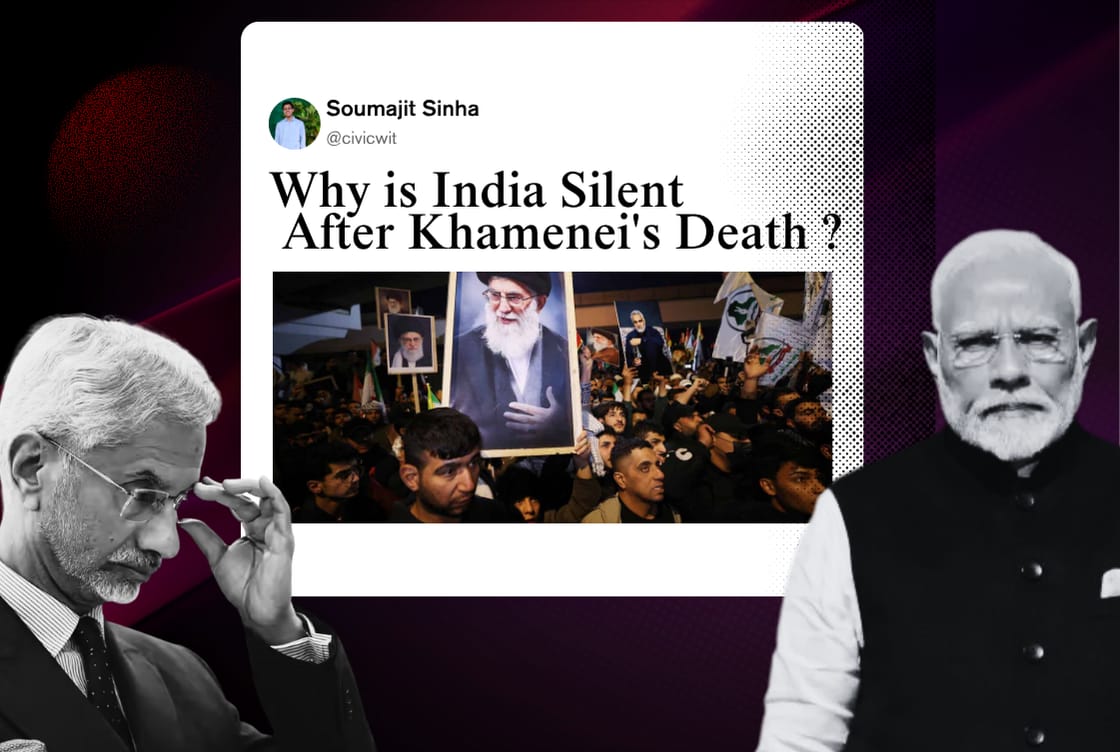
Is India’s silence on Khamenei’s death a strategic decision?
On 28th February, Iran’s Supreme Leader Ali Khamenei was killed in a joint strike by Israel and the US. Since then, the Indian government has not issued any official statement. This silence has upset many people at home, given our historical ties with Iran. People from different sides of the political spectrum have attributed this silence to growing pressure from US President Donald Trump. But that might not be the case. This silence could be strategic. Here’s an analysis of the situation from the perspective of India’s national interest.
The US has officially maintained that the goal of the strikes is to eliminate the Iranian nuclear programme once and for all. But critics of foreign affairs point out that the final objective is regime change. And from the actions of the US and Israel, it seems quite clear that both these countries are hell-bent on achieving that goal.
This chaotic and volatile situation requires India to balance itself very delicately. India’s Prime Minister Narendra Modi’s visit to Israel in the last week of February has already made it clear that India is Israel’s friend. The current regime, even after the death of Khamenei, is a sworn enemy of Israel. So it will be impossible to find Iran, Israel, and India at the same table. Now on the surface, the silence of India about Khamenei’s death may suggest that we have sacrificed Iran only for the sake of maintaining good relations with Israel and the US. But what if the US actually becomes successful in achieving its long-cherished goal?
A regime change essentially means that the new government in Iran will have friendly relations with both the US and Israel. For Iran, this means the lifting of all sanctions. For India, it means Indians can import oil and engage in trade with Iran just as it does with other democratic countries. By staying silent on the attack on Iran, India may have already positioned itself as a potential ally of a future democratic government in Iran. But all these presuppositions depend on one single question: Is a regime change possible in Iran very soon? If yes, it could be beneficial for India in many ways. If not, New Delhi will have to find a new way to mend ties with Iran while maintaining good relations with Israel and the US.
From the perspective of national interest, it is very important for India to maintain relations with all these countries. Iran is important for us from a national security standpoint as well. It is our gateway to West Asia and Central Asia. Iran also shares a border with Pakistan. And this is one of the key reasons why we cannot sacrifice our long-term relationship with Iran. Israel is important for us because it is one of the key suppliers of defence technology to India. And the importance of India’s good relationship with the US is paramount in terms of trade, technology, education, and, of course, the Indian diaspora.
Disclaimer: The author has self-attested that no AI tools were used in the writing of this article. The views and opinions expressed here are solely those of the author and do not necessarily reflect the views of Civicwit.