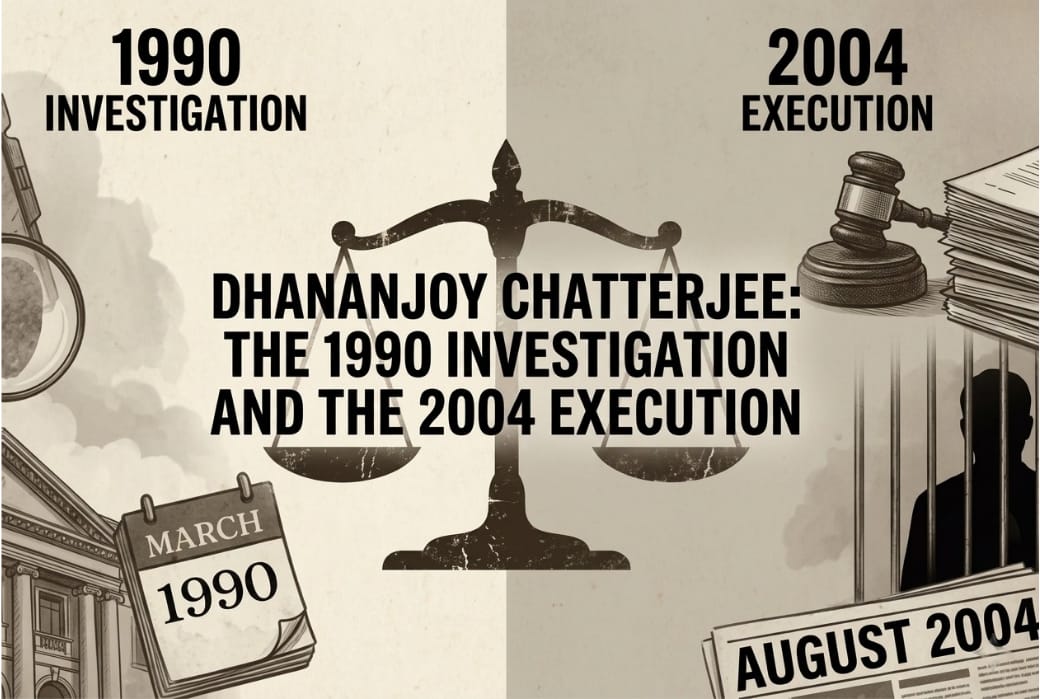
Dhananjoy Chatterjee: The 1990 Investigation and the 2004 Execution
Introduction
Criminal investigation in India is governed by the Bharatiya Nagarik Suraksha Sanhita (BNSS), 2023, which outlines procedures for evidence collection, witness examination, and case preparation. Under Section 2 (1)(1) [previously Section 2(h) of the Code of Criminal Procedure, 1973], “investigation” includes all proceedings by a police officer or authorized person for gathering evidence. An effective
investigation must begin without preconceived theories or suspects, seeking truth through objective elimination of possibilities rather than confirmation of bias.
On 14 August 2004, after trial, High Court affirmation, and Supreme Court rejection of appeals, Dhananjoy became the first person executed in 21st-century India. Yet doubts remain: was justice served, or did flawed investigation and bias lead to a wrongful conviction? This paper examines the FIR, police procedures, testimonial and forensic evidence, and the overlooked alternatives that an unbiased investigation might have revealed.
Early Event Reconstruction through FIR
The FIR in the Dhananjoy Chatterjee case presents the first formal record of the crime at Flat No. 3A, Anand Apartment, 57A & B Padmapukur Road, Bhawanipur, Kolkata, a seemingly secure upper middle residence. On 5 March 1990, around 5:20 p.m., the victim’s mother, Yashomati Parekh, left for a temple,
leaving her daughter alone in the flat. She did not carry the keys, a detail that remained unexplained by investigators.
Upon her return at roughly 6:05 p.m., finding no response at the door, she asked for help from building’s servants to forcibly enter. Inside, they discovered the girl lying bloodied and unresponsive, with her undergarments found in the drawing room and clear evidence of injury and disorder near the parents’ bedroom. The mother described her daughter as partly unclothed, with her inner skirt and blouse lifted, exposing her breasts, blood on various parts of her body. Believing her daughter had fainted, the mother searched for the security guard, Dhananjay, after being told he had visited earlier.
Unable to locate him, she, with others, attempted to move her daughter to the lift, waiting there for nearly an hour while neighbours called two doctors who declared the child dead. The mother stayed in the lift with the body until her son returned, at which point they brought the victim back to the flat, placed her on the bed and covered it with a bedsheet. Relatives and friends were contacted, and the household waited until the father arrived home at approximately 8:30 p.m. after closing their family business. The mother’s statement was taken that night by Sub-Inspector Gurupada Som.
Importantly, it was the father who first informed the police. The FIR was formally recorded only after nearly three hours had elapsed and after numerous individuals had entered and discussed the events in the flat. This delay and communal processing of the scene suggest that the FIR became a collective narrative
shaped by family consensus rather than an immediate report of the mother’s initial observations.
Statement of the Victim’s Mother and Liftman’s Testimony
The investigation began with two statements from the victim’s mother—one to police on the night of the crime and another in court. The first gave exact times (“at 7:00 p.m.”), while the later deposition used ranges (“around 6 to 6:05 p.m.”), reflecting emotional differences in recollection. Both parents used similar time expressions, showing a shared communication pattern.
Sub-Inspector Gurupada Som claimed to record her statement at 9:50 p.m., though no exact timings were noted. The police diary showed the first call at 9:15 p.m., and officers likely arrived by 9:30 p.m. Yet, SI Maloy Mukherjee (PW 26) stated he reached at 10:35 p.m. to find Som already on site, which makes the
supposed rapid sequence of investigative actions within 45 minutes seem improbable.
The mother accused Dhananjay of rape and murder, citing prior harassment and claiming liftman Ramdhan Yadav (PW 8) informed her of Dhananjay’s visit to use the telephone. In court, however Ramdhan denied this, testifying that Dhananjay was seen leaving between 5:30 and 5:45 p.m. with the supervisor, the fact consistent with staff policy restricting lift use. His steadfast testimony, despite being declared hostile, aligned with other staff and reinforced his status as an independent witness. The mother’s account, as an interested witness, thus requires corroboration, as noted in Joginder Singh v. State of Punjab (1979), where the Court stressed cautious scrutiny of familial testimonies conflicting with
neutral witnesses.
Ramdhan’s version narrows the crime window: Dhananjay’s exit by 5:45 p.m. and the mother’s discovery of the body at 6:05 p.m. Forensic indicators like rigor or livor mortis cannot fix time of death to minutes, but heavy bleeding observed (“pool of blood”) suggests the assault occurred just before discovery, not earlier.
The Credibility of the Transfer Order
The police seized Dhananjay Chatterjee’s transfer order from the Security & Investigation Bureau on 29 June 1990 , listed under item (f) with cash and vouchers. Its evidentiary value remains doubtful.
The agency’s records lacked formal documentation, and key questions were ignored at trial. Neither supervisor Pratap Chandra Pati (PW 6) nor proprietor Shyamal Karmakar (PW 21) were asked about appointment letters, similar orders for other guards, or a transfer order for Dhananjay’s replacement, Bijoy Thapa. The absence of such records, particularly for Thapa, indicates the order may have been fabricated post facto to aid the prosecution.
Its seizure nearly four months later further raises doubts. As cautioned in State of Punjab v. Baldev Singh (1999), delayed production without clear justification warrants skepticism. Despite complaints of Dhananjay’s misconduct, the agency merely transferred him instead of termination, an improbable action if the allegations were genuine. This absence of inquiry suggests the complaint or the order itself may have been retrospectively created.
Pratap Chandra Pati, supervisor of the agency further claimed that when guard Dasarath Murmu (PW 7) failed to reach Dhananjay by intercom, he called out from the ground floor, and Dhananjay replied from the victim’s third-floor balcony. This is spatially impossible. As per PW 1 Santanu Basu’s sketch, the
guard post was inside the building near the lift, while the victim’s balcony faced east above the main gate, obstructed from view by the structure and elevation. The balcony is visible only from the side lane outside the gate.
Analysis of the Three Material Evidences Found
The prosecution’s case against Dhananjay rests on three pieces of material evidence : a Ricoh ladies’ wrist watch, a cream coloured shirt with a missing button, and a broken chain. Additionally, hair strands were recovered from the scene.
A) The Ricoh Wrist Watch
On 6 March 1990, the day after the crime, the victim’s mother searched the apartment and reported that a Ricoh wristwatch worth Rs. 350 was missing, alleging that Dhananjay had stolen it.
The watch was recovered from Dhananjay’s home in village Kuludihi, Bankura over two months later, on 15 May 1990. The serial number was not cross-verified against the sales register, despite the salesman, Md. Fakhariddin maintained one. The mother identified the watch based on its appearance alone, and the
letter reporting the theft bore no timestamp and general diary entry number, raising concerns about possible backdating. Additionally, while the mother had the watch’s guarantee card, the purchase invoice was missing, an unusual situation, as these items are usually kept together.
If Dhananjay had stolen the watch during the crime, why keep it visibly at home for months? Furthermore, the prosecution never explained why only this item was taken by him, ignoring other valuable possessions in the affluent family’s flat.
B) The Cream Coloured Shirt and Missing Button
A cream-coloured shirt with a missing button was seized from Dhananjay’s residence, wrapped in a newspaper dated 11 December 1989. Forensic report noted that all buttons except the third from the top were cream-coloured; the third was white and stitched with different thread. Beneath this button, a “mark
of application of force, downward” was recorded, but no blood stains were found on the shirt.
The prosecution’s narrative raises doubts: the victim sustained 22 blunt force injuries, likely causing blood transfer onto the attacker’s clothes, yet the shirt was spotless. The so-called “mark of force” could be a crease from washing or storage, not necessarily evidence of violence. Furthermore, violent struggles tend to impact the collar or neck area, not the middle of the shirt where the button is missing. Given th victim and accused’s similar height, damage would more logically appear around the collar. Dhananjay testified the shirt was new, gifted by his father-in-law, and never worn before the crime, a claim unchallenged by the prosecution.
C) The Broken Chain
The chain, described as a “special type easily available in the market” was given to Dhananjay by Gouranga Chandra Paul (PW 11), lacked unique identifying characteristics. Unlike the watch, the chain had no apparent value or theft motive. The chain was found in an easily located area, enabling the victim’s father to discover it within 45 minutes.
D) Hair Strands
Hair strands recovered from the scene were never DNA tested. Modern forensics allows for mitochondrial or nuclear DNA profiling of hair , which can conclusively link or exclude suspects. In Surendra Koli v. State of U.P. (2011), the Court emphasised that failure to conduct available scientific test, can support an
argument of investigative bias or incompetence.
Post Mortem Examination
The post-mortem report found no ligature marks on the neck. The examiner concluded death resulted from smothering with antemortem strangulation. The stomach contained 100 grams of undigested food, and fresh hymenal tears appeared at the 4, 5, and 7 o’clock positions. About 22 injuries were present,
primarily on the face and neck, with no injury to the breasts or genitals beyond the hymenal tears.
The absence of genital or breast injuries contrasts with typical patterns in forcible assaults. Sommers (2007) reported genital injuries in 50–90% and extragenital injuries in 46–82% of such cases. Here, multiple facial and neck wounds suggest resistance, yet genital injuries are minimal, an anomaly in violent rape. Lincoln et al. (2013) found non-consensual intercourse usually results in multiple severe
genital injuries, unlike the isolated tears often seen in consensual acts. A review by Naumann et al further notes that numerous extragenital injuries with limited genital trauma are atypical for rape, hinting at consensual intercourse rather than forced sex.
Hymenal tears alone are inconclusive; they occur in both consensual and forced intercourse and may heal quickly. Studies of adolescent sexual assaults survivors found that fewer than half sustained hymenal injuries, and tears occurred in less than 25% of cases. The lack of labial bruising or vaginal lacerations
supports the inference that penetration, if any, was not forcibly achieved.
Gastric Content Analysis
The post-mortem report found the victim’s stomach contained 100 grams of mucoid, undigested food with no odour. Forensic studies show gastric emptying varies from 1 to 10 hours, depending on factors like meal size and individual metabolism. Under normal conditions, the stomach empties within 4-6 hours of
eating. If contents remain largely undigested, death likely occurred within 1-2 hours of the meal. In one study of 1,000 cases, recognizable food was present in about 39% where death happened within four hours of ingestion.
The victim’s mother testified she returned home from school at 1:00 p.m., likely ate within 2–3 hours (around 2:00–3:00 p.m.), which suggests death could have occurred around 4:00–5:00 p.m. If this timeline is accurate, the victim was not alone at the time of death, which conflicts with other evidence. However, a landmark 1979 study by Jaffe warns that gastric emptying times are imprecise, especially without exact meal details or environmental factors, making time estimates approximate at best.
Analysis of Injuries
The victim sustained 22 injuries: 19 on the face and neck, one on the left elbow, and one on the right hip, with none on the breasts or genitals apart from hymenal tears. Two were fatal: a nasal bridge fracture and a hyoid bone fracture with dislocation.
Hyoid fractures, found in 34–73% of manual strangulations but far less in ligature or hanging cases, result from bilateral compression of the neck. The hyoid fracture, coupled with the absence of ligature marks, confirms manual strangulation as the cause of death.
Forensic Serology Findings
The Forensic Science Laboratory reported blood belonging to the victim (blood group B) on her panty, midi underwear, and traces on her pink skirt, while the cream-coloured shirt seized from Dhananjay showed no blood or semen stains. Additionally, Dhananjay’s blood type did not match the blood found at
the scene, excluding him as the source.
Trace semen was found on the victim’s underwear but none was detected in the vaginal swab. Semen can usually be detected in vaginal swabs for up to 72 hours post-intercourse. Its absence here suggests that either the sexual activity occurred earlier than the time of death, ejaculation did not occur intra-vaginal, or the swab collection was improperly conducted.
DNA is admissible under section 39(1) of the Bharatiya Sakshya Adhiniyam, 2023 (formerly, section 45of the Indian Evidence Act, 1872) as expert opinion evidence.
No DNA testing wasn’t conducted on the semen despite the availability of technology in 1990 and its importance in a rape-murder case. This investigative omission is a major failure, undermining the prosecution’s case. DNA analysis could have either conclusively linked Dhananjay to the crime or exonerated him.
Two Transaction Theory
The forensic evidence presents a logically incoherent sequence if one accepts the prosecution’s theory that rape and murder occurred as a single transaction. The sexual intercourse and the murder were separate transactions, committed by different persons, at different times and/or locations.
Conclusion
A Times of India report (30 June 2004) revealed that Kajal Bagchi, a neighbour and the last person to see the victim alive, stated the victim often visited a “Gujarati gentleman” upstairs for study help. On the day of the murder, she told Bagchi she planned to meet him but left when he was absent, intending to
return after lunch but she never did.
Despite this key testimony about the victim’s last movements, police never questioned Bagchi or called her as a witness. Under Section 165 of the Indian Evidence Act (now, Section 168 of the Bharatiya Sakshya Adhiniyam 2023), the judge could have examined her to seek the truth, and the omission to do so
reflects a lapse in judicial duty that hindered vital fact-finding. In the trial, Dhananjay’s defence relied on plea of alibi that he was at the cinema during the crime, a claim could have been easily verified but was never. Whether Dhananjay Chatterjee was guilty or innocent, India owed him a fair trial based on proper
investigation, comprehensive evidence evaluation, and judicial commitment to truth.
Disclaimer: The views and opinions expressed in this article are those of the author and do not necessarily reflect the views of CivicWit.